
Our longings are made for beauty.Tracing the eternity set in our hearts
Twelve healing movements for a longing heart—my free guide for subscribers.
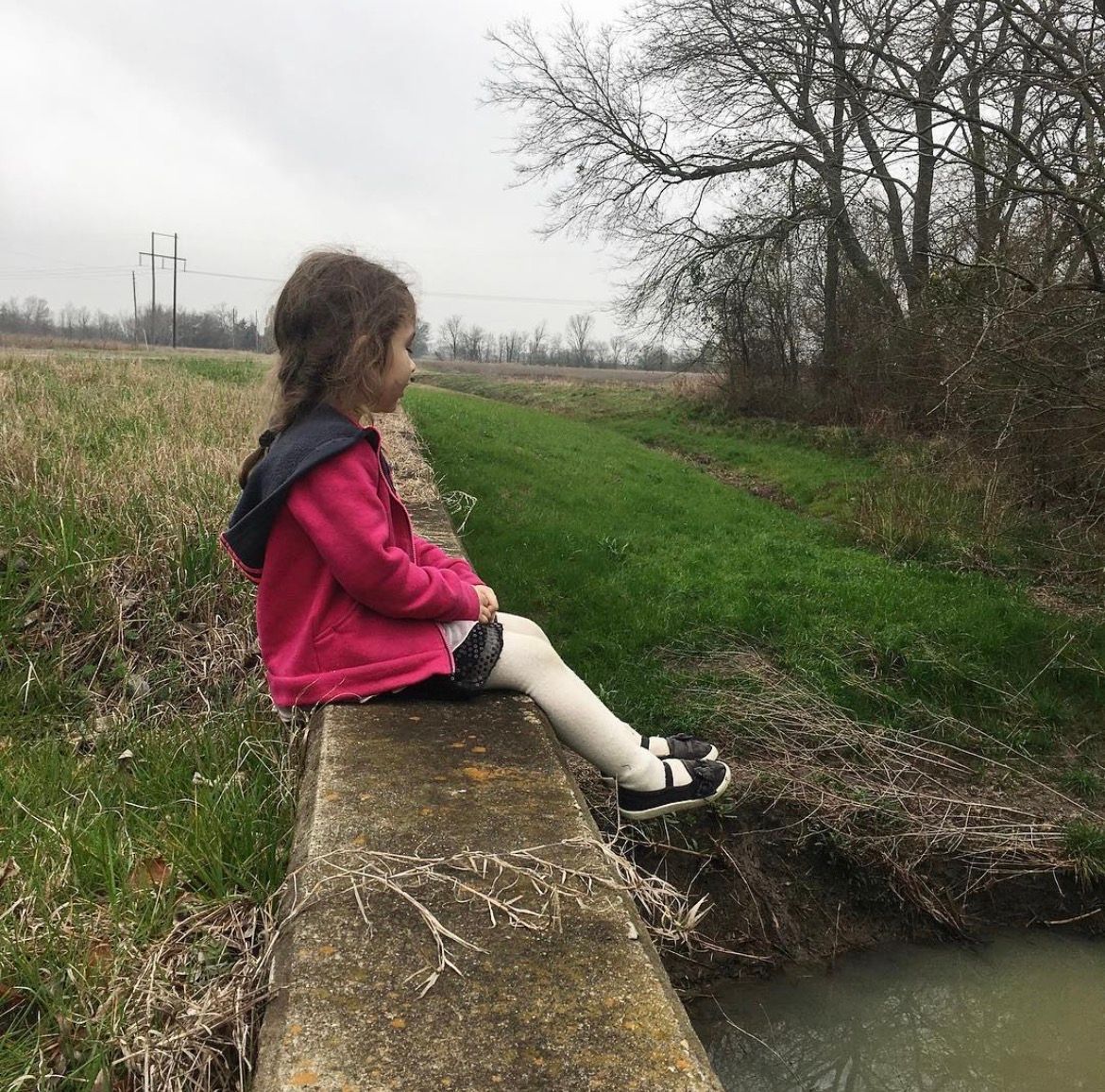
When my daughter Liesel was very small, she wanted to make a robot-like doll. While our girl always kept a creative project going, it felt special to watch her give this robot more care than any project she’d made before. This guy would be her buddy. A cardboard box in the yard became her work station. She gathered air-dry clay, paint, plastic caps, broken toys, and odd pieces of metal. For a four-year-old, she put an immense level of thought into how she wanted to craft him. She painted the pieces, carefully pressing each one into the clay blob of his head. Then, with heartfelt care, she formed his face. Ready for the clay to dry, she showed us her work with utmost delight—the plastic cap eyes painted black and white, the antennae aligned just right. Her new friend was coming to life, and his face lit up her smile. She inserted the piece she would use to form his body and made sure he was comfortable while he dried. But close by hovered the curious toddler hands of Baby Brother. Tragedy struck when he yanked a piece away before the clay fully hardened, damaging her beloved new friend. Tears streaking her face, Liesel’s features twisted in horror. In the awful realization, her voice trembled, hollow and broken. “ Mommy. He is…ruined.” This was nothing like when her towers got knocked down. This was the depths of her heart laid out with love and smashed. I offered all the hugs and comfort I knew how to give, but to her, this devastation seemed more than she could bear. I looked at her robot and thought of pain I’ve known that could never be undone. I told her I was so sorry. And I asked her to not give up on Mr. Robot. With the same hollow quiver in her voice, she told me what she couldn’t ignore. He would never be the same. I agreed and my heart broke too. I longed to see more of the joy her new friend brought her. “You made him, and I know you can re-shape him.” With a half-whisper, half-prayer, I hoped she would keep on. While I worked in the kitchen, I kept an eye out the back door window. She sat in the swing with her head down. Mr. Robot sat a few yards away in his box, and she couldn’t bring herself to look at him. A half hour later, she had hardly moved. I watched and waited. And I prayed, because this felt big, like a story that would continue to live inside her. Then, I caught sight of a change. While I dried my hands, I moved toward the window to spot the sway of the empty swing. Liesel knelt beside the box with Mr. Robot in her hands, staring into his face—his ruined face. How do you bring yourself to look at the ruined face of what you’ve made? How do you stare at the misshapen remnants of a dream you built with your hands and formed with your love? I’d been reading Elisabeth Elliot’s writing about what helps us find courage for difficult moments. She recalls the rainbow’s end that keeps champions charging forward. “The heroes of the world’s great legends let themselves in for all kinds of fearsome troubles because of the promise of a great reward—the favor of the king, a pot of gold, marriage to a princess. Because there was a shining goal, they entered in with heart and will to participate in the as-yet unseen and unknown hazards of the dreadful journey. Their heroism lay in acceptance—a wholehearted acceptance of conditions other men would avoid at all cost—and in endurance. The dark caves, tunnels, and labyrinths were not problems to be solved but hazards to be traversed, the storms and heavy seas were to be braved, the giants and monsters to be slain. All were accepted and endured in view of the prize. ”* Elliot considers the moments when the hazard we’re given to traverse “is not presented to us in the form of martyrdom, heroic action, dragons or labyrinths…”** But what about the moments when the “dragon” we’re to face is the fear of our own pain when we see the damaged remains of a dream? From the window, it seemed Liesel’s heart must’ve caught sight of a shining prize, because she reached for another piece. With a little time, she found a way to work with that same clay head and reform Mr. Robot’s face. And though it wasn’t the same as before, his eyes brought her even more delight. After she finished Mr. Robot, he claimed a special spot on Liesel’s desk at night and would accompany us on trips into town. When we went out to eat, he sat on the table beside her, fiercely protected from Baby Brother. His presence often sparked questions from passersby, and she proudly showed him off with her biggest smile of all. One waitress shared how her daughter had also made a creature whom she carried with her everywhere. I wondered what lay beneath the surface of that story. When she asked me to tell her more about Liesel and her robot, I didn’t know how to do more than touch the surface of all Mr. Robot represented. I only knew that when I saw Liesel beaming there next to him, my heart felt full with the memory of when she slayed a dragon in our backyard. To watch a child kneel beside a broken dream is a gift. The quiet memory of her courage points me to the One who gave me the joy of life with her. I remember the shining prize of Him. He is the Maker-Friend who can always be trusted to redeem the ruined. *** Years later, I stepped into my kids’ room and noticed the overflowing box of toys. I rummaged through its contents to see what may have reached its time—a doll better suited for a younger child, a stuffy that saw the washing machine too many times. At the bottom of the box lay broken pieces of clay. Not sure what I was looking at, I placed them together on the floor. Then I found a plastic cap, painted black and white—an eye. It belonged with the clay. The remains. Mr. Robot. _______ *Elisabeth Elliot, The Path of Loneliness, pp. 107-108. **Eliot, The Path of Loneliness , pp. 111-112.

A patch of irises sits beyond our backdoor. The iris have grown there longer than I can remember. They may have been planted by my great grandmother, or the Craven family who lived here before her. I know they’ve weathered some hard years. One year, a child picked them all just as they bloomed. Some years, they bloom before the last winter freeze. Before we lived at the farm, I’m told the whole iris patch was mowed down with aims to kill it for good. I don’t believe the iris bloomed that year, but they did grow back to bear their purple blooms. This summer, my girls dug in the dirt beside the patch and uncovered a hidden brick pathway. Somebody gave careful thought to how and where to plant those hardy perennials. Though I’ve yet to learn how to give them care, they still greet me every year with their color. No matter how short a time the iris gets to bloom, no matter how the weather and the hands of others affect them, they follow their design. When the earth gets warm and damp after the cold, they turn beautiful again. My kids’ discovery of the brick pathway gave me more thought to them this year, and how resilient they are. A few difficult years in a row won’t stop them. Even a lawn mower can’t kill them. These trials seem to result in more hearty growth to come. An iris patch will produce blooms for an average of 3-5 weeks a year and the iris are content to stand as bare stalks for the rest of the time. It’s as if the iris is hardwired to know, even if a child picks her the very day she blooms, the whole year was worth it for the beauty she brought that day. So she’ll do it year after year. When I think of the one who planted the iris patch, I think of the human struggle to trust the goodness of what we share with our hands, and with our lives. Some seasons you bloom just before the freeze. Some seasons you are mowed down by life. Perhaps a perennial faith keeps choosing to trust there is purpose in the bloom before, even despite the freeze—so there’s purpose in opening again. Before I was born, hands planted a bulb in the dirt, not knowing who would enjoy it. And each day, hands are at work to share good gifts. In Scripture, Job spoke of the resilience of plants that sprout again after being cut down (Job 14:7). When he remembered them, he remembered hope. And how he needed hope. At the peak of bloom, Job’s life was mowed down. With all his livestock destroyed and his ten children killed, his flesh was eaten by pain, while his friends mocked him and his wife told him to go die. In Job’s grief, he compared his life to a withered flower (Job 14:2). Yet even amidst those thoughts, he remembered the plants which sprout again, and though his memory of hope was a small passing thought, it was there in the growth he’d witnessed before—buried deep within him. Rooted expectations are powerful no matter how softly they rise. Job’s life did bloom again. And perennial faith does not require that one never feel small, though it invites the soul to be awed by the simple memory of hope. “For there is hope for a tree, if it be cut down, that it will sprout again, and that its shoots will not cease. Though its root grow old in the earth, and its stump die in the soil, yet at the scent of water it will bud and put out branches like a young plant.” Job 14:7-9
When I was in the throes of my mid-twenties, feeling blindsided by the reality of life, someone I looked up to told me, “Whatever feels like love to you, feel free to go and do it.” There was both deep goodness and hidden instability in that moment. To understand why, you may need to know the season I was in. During most of my teen years, I struggled a lot with religious shame. I coped with it by giving myself a rigid dress code and pretending to be uninterested in boys because it made me feel more righteous. By now, I felt I’d lived enough hypocrisy in high school to last a lifetime. I wanted my twenties to be different, yet internalized mindsets don’t untangle on their own. With an early faith built largely on what I suppressed, I’d grown to fear many of my own desires—including everyday, ordinary impulses to share moments of connection with others. The habits of my younger years kept bleeding into the present. I needed to change something. I longed to freely let go of “cleaning my outsides,” so I could give attention to my inner life. Jesus’ words to the Pharisees left me feeling exposed. “Woe to you, scribes and Pharisees, hypocrites! For you clean the outside of the cup and the plate, but inside they are full of greed and self-indulgence” (Matt. 23:25). Though I longed for authenticity, I felt trapped by fear. What if I make the wrong move? I believed if I kept trying to give my energy to “keep the outside of my cup clean,” I would have nothing left for the inside. And I felt scared I’d take it too far. For me, cleaning the inside of my cup meant learning how to live my faith from desire more than duty. I wanted to live, not from obligation, but a life that genuinely resonated with the specific design of my person. I felt overwhelmed between what to throw out and what to hold onto, and I truly needed words of assurance. Don’t be afraid to practice love. “There is no fear in love, but perfect love drives out fear, because fear has to do with punishment. The one who fears is not made perfect in love” (1 John 4:18). I firmly believe it’s the essence of what my Christian mentor wanted me to know when the words were shared: “Whatever feels like love to you, feel free to go and do it.” On the one hand, those words ministered to me. They gave me the gumption that woke me from a kind of paralysis. And on the other hand, “whatever feels like love to you” is a phrase my mentor later wanted to rephrase. Of course, I knew I didn’t want to go crazy. There were certain moral lines I knew I wanted to stay inside. Yet, for sake of authentic faith, certain structures had to go…and I didn’t know which. My mentor’s advice made me wonder… maybe I can depend a lot more on an inner sense of love? Well, when I exercised the things that felt like love to me at the time, it resulted in damaged friendships, boundary issues and depression. Just like music needs certain structures to guide emotional expression, my love needed guardrails as well. I may as well have jumped on a stage, pulled out a banjo, and played whatever felt like music to me. (I don’t know banjo music.) The definitions I find of the word “music” vary greatly. Some emphasize words like “organization, structure, pattern, rhythm” while others emphasize words like “art, expression, emotion, experience.” The music I most enjoy has a great balance of both. Emotional expression without structure, or vice versa, can become either chaotic and annoying, or boring and empty. The downside of “whatever feels like love to me” is that it quickly becomes chaotic to the point of misery. It’s no wonder that when Paul instructed Timothy on how to lead well, he said, “The aim of our charge is love that issues from a pure heart and a good conscience and a sincere faith. Certain persons, by swerving from these, have wandered away into vain discussion” (1 Tim. 1:5-6). Paul didn’t want chaos for Timothy and offered structure for the mission. Scripture teaches authenticity, and it also teaches the structural pillars of health and joy. While my mentor’s initial advice didn’t share that structure, it still became a gift that helped me find courage to stop ignoring my heart. The moment when I considered “what feels like love” helped me acknowledge how my life at the time drained me. My heart felt unengaged. The cycle of duty and burnout I lived did not speak of harmony, and my life felt off course in ways hard to name. Proverbs warns that the wellspring of life comes from the heart and that we must care for that wellspring with vigilance (Prov. 4:23). If my heart is sending me alert signals that my way of life is draining me, wisdom requires me to notice. A heart built on duty, while desire goes ignored, is a heart where love needs room to breathe. In the book of Exodus, when Jethro saw Moses living out of a grueling sense of duty that left him completely empty, Jethro called Moses to pay attention, saying, “What you are doing is not good. You and the people with you will certainly wear yourselves out” (Ex. 18:17-18). The level of exhaustion Moses was serving from, left him where he could hardly live from love anymore. They found a solution which balanced responsibility with the genuine needs of Moses. When I become so afraid to listen to my heart that I ignore the moments which leave me weary and empty, I am invited to more. Jesus’ call is “Come to me, all who labor and are heavy laden, and I will give you rest” (Matt. 11:28). The instinct that love needs structure is entirely correct, yet love also requires emotional authenticity—and it’s entirely worth the risk to practice learning to balance both. It’s good to notice when a path leaves me struggling to love from my heart, and to consider what love would do. Love won’t rush me to decide a new way. Yet, it won’t leave me defeated by the fate of an empty life. The imperfect advice I received still helped me find the courage I needed, and we are loved by a God who takes our human attempts at love and redeems them for good. So, if you know moments of paralyzing fear yourself, I want to pass the encouragement on—even if I say it imperfectly. Don’t be afraid to go and practice love. While religious shame stifles your spirit, true structural health will protect it. The goal is a harmony of love that springs up from a tended inner life—from the rhythms of a clean heart, a clear conscience, and unfeigned trust in God.